






 Live Chat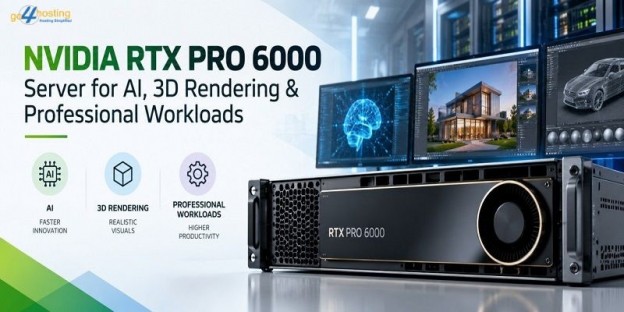
Table of Content
- What Is an NVIDIA RTX PRO 6000 Server?
- Key Specifications of NVIDIA RTX PRO 6000
- NVIDIA RTX PRO 6000 GPUs for AI Workloads
- NVIDIA RTX PRO 6000 for 3D Rendering
- Professional Workloads and Virtual Workstations
- Video Processing and Content Creation
- Why Data Center Infrastructure Matters
- NVIDIA RTX PRO 6000 Server and Server Colocation
- Who Should Consider an RTX PRO 6000 GPU Server?
- How to Choose the Right RTX PRO 6000 Server
- Conclusion
The NVIDIA RTX PRO 6000 Blackwell Server Edition is designed for demanding enterprise workloads that require powerful GPU acceleration. Built on NVIDIA’s Blackwell architecture, it combines AI computing, professional graphics, rendering, simulation, and video capabilities in a data-center-ready platform.
The GPU features 96GB of GDDR7 memory, 24,064 CUDA cores, fourth-generation RT Cores, and fifth-generation Tensor Cores. It supports up to 600W of configurable power and uses PCIe Gen 5 x16 connectivity. NVIDIA also specifies up to 1,597 GB/s of memory bandwidth for the Server Edition.
In this guide, we will explore how an NVIDIA RTX PRO 6000 Server can support AI, 3D rendering, professional visualization, video processing, and other GPU-intensive applications. We will also discuss GPU server infrastructure, Server Colocation, and the role of a modern Data Center in deploying these systems.
What Is an NVIDIA RTX PRO 6000 Server?
An NVIDIA RTX PRO 6000 Server is a server platform equipped with the NVIDIA RTX PRO 6000 Blackwell Server Edition GPU. Unlike a typical desktop graphics card, the Server Edition is designed for enterprise server environments and multi-GPU deployments.
The GPU uses passive cooling and is designed for continuous operation in data-center environments. NVIDIA positions it for workloads including AI inference, fine-tuning, distributed rendering, high-performance computing (HPC), and virtual workstations.
This makes the RTX PRO 6000 Server suitable for organizations that need centralized GPU resources instead of relying on individual workstations.
Key Specifications of NVIDIA RTX PRO 6000
The RTX PRO 6000 Blackwell Server Edition provides several specifications that make it suitable for demanding workloads.
| Feature | Specification |
|---|---|
| GPU Architecture | NVIDIA Blackwell |
| GPU Memory | 96GB GDDR7 with ECC |
| CUDA Cores | 24,064 |
| RT Cores | 188, 4th Generation |
| Tensor Cores | 5th Generation |
| Memory Interface | 512-bit |
| Memory Bandwidth | Up to 1,597 GB/s |
| System Interface | PCIe Gen 5 x16 |
| Power Consumption | 400–600W |
| Thermal Design | Passive |
| MIG | Up to 4 isolated instances |
These specifications provide a strong foundation for AI, graphics, simulation, and professional computing applications.
NVIDIA RTX PRO 6000 GPUs for AI Workloads
AI workloads often require substantial GPU memory and parallel processing capability. The RTX PRO 6000 addresses these requirements with 96GB of GDDR7 memory and fifth-generation Tensor Cores.
The GPU can support applications such as:
- AI inference
- Generative AI
- Machine learning
- Large AI models
- Data analytics
- Scientific computing
- AI-assisted content creation
Moreover, NVIDIA supports FP4, FP8, FP16/BF16, and TF32 Tensor Core workloads on the Server Edition. This allows developers and enterprises to select appropriate precision levels based on their application requirements.
For organizations running multiple users or applications, Multi-Instance GPU (MIG) can create up to four isolated GPU instances. Each instance can have dedicated resources, helping organizations share GPU infrastructure more efficiently.
NVIDIA RTX PRO 6000 for 3D Rendering
3D rendering requires significant graphics processing power, particularly when applications use real-time ray tracing and complex scenes.
The RTX PRO 6000 includes fourth-generation RT Cores designed to accelerate ray-traced workloads. NVIDIA states that these RT Cores can deliver up to twice the performance of the previous generation.
As a result, an RTX PRO 6000 GPU Server can be useful for:
- Architectural visualization
- Product design
- 3D animation
- CAD applications
- Digital twins
- Visual effects
- Engineering visualization
- Photorealistic rendering
Meanwhile, organizations can centralize rendering resources in a server environment rather than maintaining high-end GPU workstations for every employee.
Professional Workloads and Virtual Workstations
Professional users increasingly need access to GPU-accelerated applications from different locations. A centralized GPU server can provide the required resources through virtual workstations.
The RTX PRO 6000 Server Edition is supported for NVIDIA RTX Virtual Workstation environments. This enables organizations to deliver graphics-intensive applications to users while keeping computing resources inside the data center.
This approach can benefit engineering teams, architects, designers, media professionals, and developers who require powerful graphics performance without purchasing individual high-end workstations.
Video Processing and Content Creation
The RTX PRO 6000 also includes dedicated video processing hardware. Its ninth-generation NVENC engines accelerate video encoding, while sixth-generation NVDEC engines handle video decoding. NVIDIA highlights support for formats and workflows including H.264, HEVC, and AV1.
Therefore, a GPU server based on the RTX PRO 6000 can support professional applications such as:
- Video editing
- Video transcoding
- Streaming
- Media production
- AI-powered video workflows
- Content creation
Additionally, multiple GPU resources can help organizations handle several concurrent workloads.
Why Data Center Infrastructure Matters
Installing a powerful GPU is only one part of building an effective GPU infrastructure. The surrounding Data Center environment also plays an important role.
High-performance GPUs can consume substantial power. The RTX PRO 6000 Server Edition supports configurations between 400W and 600W. Therefore, servers require appropriate power delivery, cooling, networking, and rack infrastructure.
A professional data center can provide:
- Reliable power infrastructure
- High-capacity cooling
- Network connectivity
- Physical security
- Rack space
- Monitoring
- Redundancy
- Controlled operating environments
These factors become particularly important when organizations deploy multiple GPUs in the same server or across multiple servers.
NVIDIA RTX PRO 6000 Server and Server Colocation
Organizations that do not want to build their own data center can consider Server Colocation. In a colocation model, the organization owns or leases server hardware while placing it inside a professionally managed data-center facility.
For an RTX PRO 6000 GPU Server, colocation can provide access to data-center infrastructure without requiring the organization to construct and operate its own facility.
However, businesses should evaluate several factors before choosing a colocation provider. These include power availability, cooling capacity, rack density, network options, physical security, remote-hands support, and scalability.
For high-density GPU deployments, power and cooling requirements deserve particular attention.
Who Should Consider an RTX PRO 6000 GPU Server?
The RTX PRO 6000 Server can be useful for organizations with sustained GPU-intensive workloads.
Potential users include:
AI and Machine Learning Teams
AI developers can use the GPU for inference, model development, and other accelerated computing workloads.
Architecture and Engineering Firms
Design teams can use GPU resources for 3D visualization, simulation, CAD, and rendering.
Media and Entertainment Companies
Studios can use GPU servers for rendering, video processing, visual effects, and content production.
Research Organizations
Scientific and research teams can benefit from GPU acceleration for computationally intensive applications.
Enterprises
Large organizations can use centralized GPU infrastructure to provide shared computing resources across departments.
How to Choose the Right RTX PRO 6000 Server
Before deploying an RTX PRO 6000 Server, organizations should evaluate their actual workload requirements.
First, determine how much GPU memory applications require. The 96GB memory capacity can be valuable for large AI and graphics workloads, but workload sizing remains important.
Next, consider the number of GPUs required. A single-GPU configuration may be sufficient for some applications, while AI and rendering environments may benefit from multi-GPU systems.
Additionally, evaluate CPU, system memory, storage, networking, power, and cooling. A powerful GPU cannot reach its full potential if other components create bottlenecks.
Finally, consider whether purchasing hardware or using Server Colocation better fits the organization’s operational and financial requirements.
Conclusion
The NVIDIA RTX PRO 6000 Server brings Blackwell-based AI and professional graphics capabilities to enterprise data-center environments. With 96GB of GDDR7 memory, 24,064 CUDA cores, fifth-generation Tensor Cores, and fourth-generation RT Cores, it targets demanding workloads across AI, 3D rendering, simulation, visualization, and video processing.
For businesses, the value of an RTX PRO 6000 GPU extends beyond raw performance. A properly designed GPU Server can provide centralized resources for multiple teams and applications. Furthermore, professional Data Center infrastructure or Server Colocation can help organizations deploy and operate high-power GPU systems more efficiently.
As AI and professional visualization workloads continue to grow, high-performance GPU infrastructure can become an important component of modern enterprise computing.
 About admin (157 Posts)