




 Live Chat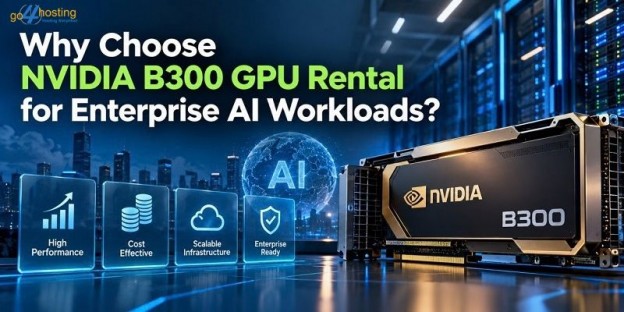
Table of Content
- What Is NVIDIA B300 GPU Rental?
- 1. High Performance for Enterprise AI Workloads
- 2. Reduce Infrastructure Investment
- 3. Scale AI Infrastructure as Needed
- 4. Access Advanced Data Center Infrastructure
- 5. Support Large-Scale AI Model Development
- 6. GPU Rental vs. Purchasing GPU Hardware
- 7. Role of Server Colocation in Enterprise AI Infrastructure
- 8. Enterprise Use Cases for NVIDIA B300 GPU Rental
- 9. How to Choose the Right NVIDIA B300 GPU Rental Provider
- Conclusion
rtificial intelligence is transforming how enterprises operate, innovate, and compete. Businesses now rely on powerful computing infrastructure to train large language models, run generative AI applications, and process complex datasets. However, building an AI infrastructure requires significant investment in hardware, power, cooling, and maintenance. NVIDIA B300 GPU rental offers an alternative by allowing businesses to access advanced computing resources without purchasing expensive hardware. Organizations can use these GPUs to support demanding AI workloads while managing infrastructure costs.
The NVIDIA B300 GPU, part of NVIDIA’s Blackwell Ultra platform, is designed to support advanced AI training and inference. It features 288 GB of HBM3e memory and delivers high memory bandwidth for handling large AI models. These capabilities make it suitable for enterprise applications that require substantial computing power and memory capacity.
In this blog, we will explore why enterprises choose to rent NVIDIA B300 GPUs for AI workloads. We will discuss performance, scalability, cost efficiency, infrastructure requirements, and the role of data centers and Server Colocation in supporting enterprise AI operations.
What Is NVIDIA B300 GPU Rental?
NVIDIA B300 GPU rental allows businesses to access high-performance GPU infrastructure through a cloud or infrastructure provider.
Instead of purchasing physical GPUs, organizations rent computing resources for a specific period. Providers manage the underlying infrastructure, including hardware, power, cooling, and network connectivity.
The NVIDIA B300 belongs to the Blackwell Ultra GPU family. It supports demanding AI workloads, including large language model training, generative AI, and high-performance inference.
Key Features of NVIDIA B300 GPUs
The NVIDIA B300 GPU offers several features that support enterprise AI operations:
- 288 GB HBM3e memory: Supports large AI models and memory-intensive workloads.
- High memory bandwidth: Helps move large volumes of data efficiently between memory and processing units.
- Advanced AI computing: Supports demanding training and inference workloads.
- Blackwell Ultra architecture: Provides advanced computing capabilities for enterprise AI applications.
- Scalable infrastructure: Allows businesses to deploy GPU resources according to workload requirements.
These features make the B300 suitable for organizations that need substantial computing resources for complex AI projects.
1. High Performance for Enterprise AI Workloads
Enterprise AI applications often require substantial computing power. Traditional computing infrastructure may struggle to handle large models and complex workloads efficiently.
The NVIDIA B300 GPU supports advanced AI processing through its Blackwell Ultra architecture and high-bandwidth memory.
AI Model Training
Training large AI models involves processing massive datasets and performing complex mathematical operations.
B300 GPUs can support demanding training workloads, including:
- Large language model training.
- Generative AI model development.
- Deep learning research.
- Enterprise-specific AI model development.
High memory capacity helps organizations work with larger models and complex datasets.
AI Inference
AI inference involves using trained models to generate predictions, responses, or other outputs.
Businesses can use B300 GPU infrastructure to support AI-powered applications such as chatbots, recommendation systems, and enterprise AI assistants.
The GPU’s computing capabilities help support applications that require substantial processing resources.
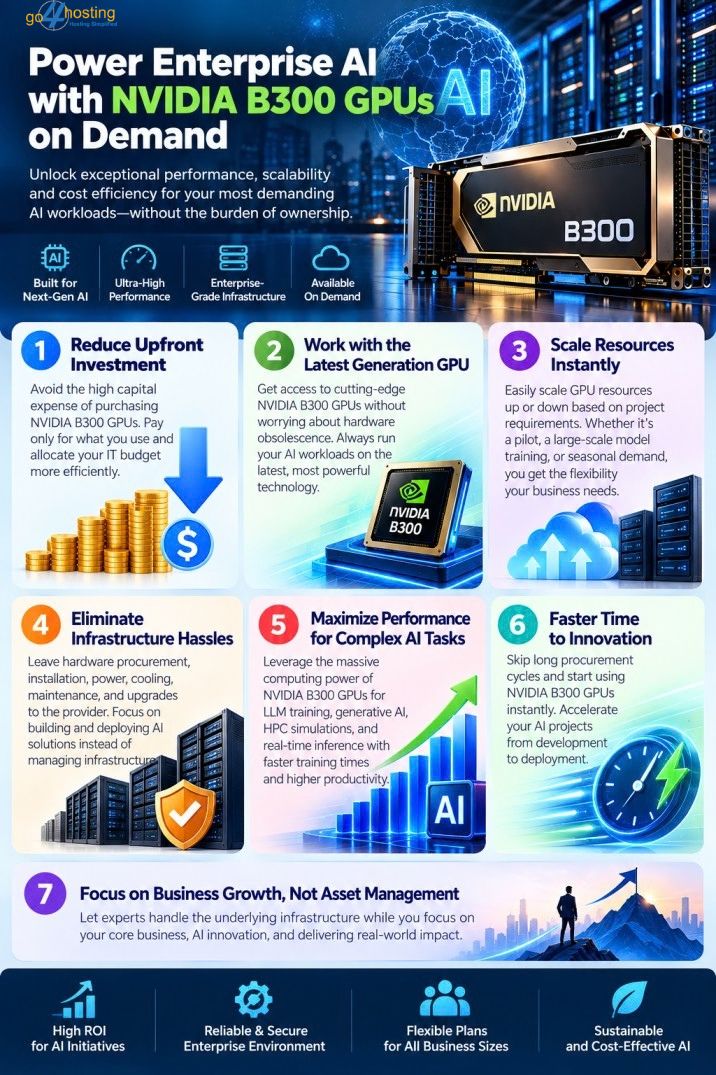
2. Reduce Infrastructure Investment
Purchasing advanced GPU infrastructure requires substantial capital investment.
Enterprises must consider hardware costs, networking equipment, power systems, cooling infrastructure, and ongoing maintenance.
Renting NVIDIA B300 GPUs offers an alternative to purchasing physical hardware.
Avoid High Upfront Hardware Costs
With GPU rental, businesses pay for access to computing resources instead of purchasing the entire infrastructure.
This approach can help organizations manage their budgets and allocate capital to other business priorities.
Improve Cost Management
GPU rental providers may offer hourly, monthly, or customized pricing models.
These options allow businesses to select a rental arrangement based on their workload requirements.
For example, a company developing an AI model for a limited period may rent GPUs for the duration of the project rather than maintain dedicated hardware throughout the year.
However, the actual cost depends on GPU availability, rental duration, infrastructure configuration, and service-level requirements.
3. Scale AI Infrastructure as Needed
Enterprise AI workloads often change over time.
A business may require additional computing resources during model training and fewer resources during development or testing.
GPU rental allows organizations to adjust their infrastructure according to changing requirements.
Flexible Resource Allocation
Businesses can select GPU configurations based on their workload requirements.
For example, an AI research team may begin with a smaller deployment and expand its infrastructure as the project grows.
Support Growing AI Projects
As AI applications become more complex, organizations may need additional GPUs, storage, and networking resources.
Rental infrastructure can help businesses expand their computing capacity without purchasing additional hardware.
However, scalability depends on the provider’s available capacity and the architecture of the deployed environment.
4. Access Advanced Data Center Infrastructure
High-performance GPUs require reliable infrastructure to operate effectively.
A modern data center provides the power, cooling, networking, and physical security needed to support enterprise AI workloads.
Power and Cooling Requirements
AI GPUs consume substantial electrical power and generate significant heat during intensive workloads.
Data centers use specialized cooling systems to maintain suitable operating temperatures.
Some advanced AI deployments use liquid cooling to manage the thermal requirements of high-density GPU systems.
Network Connectivity
AI training workloads often distribute computations across multiple GPUs and servers.
High-speed networking helps these systems exchange data efficiently.
A suitable data center environment can provide the connectivity required for demanding enterprise AI applications.
Reliability and Security
Enterprise workloads require reliable infrastructure and appropriate security controls.
Businesses should evaluate data center availability, physical security, monitoring systems, and operational support before selecting a GPU rental provider.
5. Support Large-Scale AI Model Development
Modern AI models can contain billions or even trillions of parameters.
Training and running these models requires substantial computing power, memory, and data processing capabilities.
NVIDIA B300 GPUs support demanding AI workloads through their high memory capacity and advanced computing architecture.
Large Language Models
Enterprises can use B300 GPU infrastructure to support the development and deployment of large language models.
Potential applications include:
- Enterprise chatbots.
- AI-powered customer support.
- Document processing and summarization.
- Intelligent knowledge management systems.
Generative AI Applications
Generative AI systems create content such as text, images, and other outputs.
Businesses can use GPU infrastructure to develop and deploy generative AI applications for marketing, research, software development, and business automation.
The suitability of a B300 deployment depends on model size, software optimization, memory requirements, and the number of GPUs available.
6. GPU Rental vs. Purchasing GPU Hardware
Businesses often compare GPU rental with purchasing physical hardware before selecting an infrastructure model.
Both approaches offer different advantages depending on workload requirements and financial priorities.
| Factor | NVIDIA B300 GPU Rental | Purchasing GPU Hardware |
|---|---|---|
| Initial investment | Lower upfront investment | High upfront investment |
| Hardware ownership | Provider retains ownership | Business owns hardware |
| Maintenance | Generally managed by provider | Business manages maintenance |
| Scalability | Depends on provider availability | Requires additional hardware |
| Infrastructure | Access to provider infrastructure | Requires suitable deployment facilities |
| Long-term costs | Recurring rental charges | Hardware and operating expenses |
Rental may suit businesses with variable workloads or limited infrastructure resources.
Purchasing may suit organizations that need long-term control over dedicated hardware.
Businesses should compare total costs, utilization rates, security requirements, and operational responsibilities before deciding.
7. Role of Server Colocation in Enterprise AI Infrastructure
Server Colocation allows businesses to place their own servers and IT equipment in a professionally managed data center.
Organizations retain ownership of their hardware while using the facility’s power, cooling, physical security, and network connectivity.
GPU Infrastructure and Colocation
Businesses that purchase NVIDIA B300 GPU servers may consider Server Colocation to host their equipment in a specialized facility.
This arrangement can provide access to data center infrastructure without requiring the organization to build its own facility.
However, high-density GPU servers require careful evaluation of power availability, cooling capacity, rack configuration, and network connectivity.
Colocation vs. GPU Rental
GPU rental provides access to provider-owned computing resources.
Server Colocation provides space and infrastructure for customer-owned equipment.
Organizations should choose an approach based on hardware ownership, infrastructure management, scalability, and long-term operating costs.
8. Enterprise Use Cases for NVIDIA B300 GPU Rental
NVIDIA B300 GPU rental can support various enterprise AI applications.
Healthcare and Life Sciences
Research organizations can use GPU infrastructure for medical imaging analysis, computational research, and AI-assisted drug discovery.
Financial Services
Financial institutions can use AI infrastructure for fraud detection, risk analysis, and large-scale data processing.
Manufacturing
Manufacturers can deploy AI applications for predictive maintenance, quality inspection, and industrial automation.
Technology and Software Development
Technology companies can use B300 GPUs to develop AI models, build intelligent applications, and support enterprise AI services.
The performance of each application depends on its software, data, model architecture, and infrastructure configuration.
9. How to Choose the Right NVIDIA B300 GPU Rental Provider
Selecting a suitable GPU rental provider requires evaluating technical capabilities and service conditions.
Consider the following factors before making a decision.
GPU Availability
Confirm the availability of NVIDIA B300 GPUs and the configurations offered by the provider.
Pricing and Contract Terms
Compare hourly, monthly, and long-term pricing models.
Review additional charges for storage, networking, software, and support.
Infrastructure Quality
Evaluate the provider’s data center facilities, cooling systems, power capacity, and network connectivity.
Security and Compliance
Review access controls, data protection measures, and relevant compliance certifications.
Technical Support
Check whether the provider offers technical assistance, infrastructure monitoring, and support for AI deployment.
These factors help businesses assess whether a rental service meets their operational requirements.
Conclusion
NVIDIA B300 GPU rental provides enterprises with access to advanced AI computing infrastructure without requiring them to purchase and maintain physical GPU hardware.
Its high memory capacity, advanced computing architecture, and suitability for demanding AI workloads make it a potential option for organizations developing large AI models and deploying generative AI applications.
By renting NVIDIA B300 GPUs, businesses can manage infrastructure investment, adjust computing resources, and access specialized data center facilities.
However, organizations should evaluate workload requirements, pricing, security, and infrastructure availability before selecting a provider.
Whether a business chooses GPU rental or Server Colocation, the right infrastructure strategy can help support its AI development and deployment goals.
